
FC Barcelona’s logo meaning: The pride of Catalonia
When discussing Spanish football, FC Barcelona inevitably sits at the center of attention. Few clubs can match its rich history, decorated trophy cabinet, and enduring identity as a cradle of some of the game’s greatest talents. From its philosophy to its culture, there is no shortage of talking points surrounding the Catalan giants.
Over the years, Barcelona have built a vast global following, drawn not only by success but by a distinctive style of play shaped across different eras. That identity has been refined under influential figures such as Pep Guardiola and embodied on the pitch by icons like Lionel Messi.
Yet despite its worldwide appeal, the deeper meaning behind the club’s crest remains unfamiliar to many. In this piece, nowgoalmobi.net takes a closer look at the story and symbolism behind FC Barcelona’s logo meaning.
FC Barcelona’s logo meaning
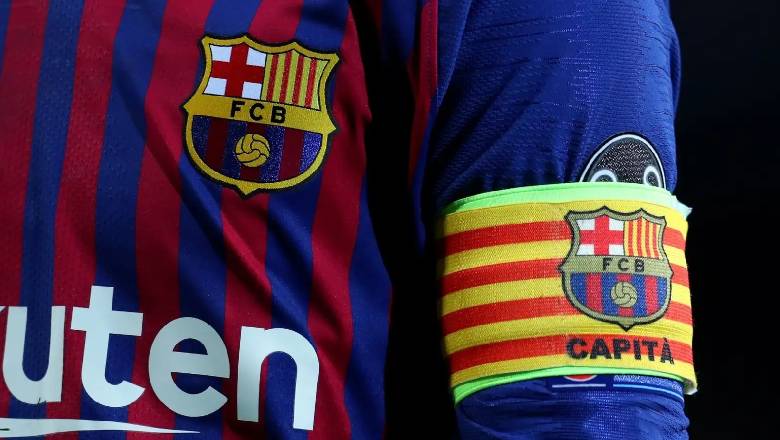
Barcelona’s crest can be divided into 4 parts:
At the top left of the crest, Cross of St. George stands out with its red cross on a white background. It represents Saint George, the patron saint of Barcelona, and underlines the club’s deep ties to the city’s identity. In Catalan culture, the figure of Saint George is closely associated with courage and protection.
On the opposite side, the top right features the iconic Senyera. The four red stripes set against a yellow field reflect the historic flag of Catalonia. This element carries strong political and cultural meaning, reinforcing the idea of Barcelona as a symbolic national team, often linked to the phrase “Més que un club”.
At the heart of the badge sit the initials FCB. Their presence has not always been constant. During the rule of Francisco Franco, the club was required to adopt the Spanish-sounding CFB, before returning to its original form in 1974.
The lower section is defined by the familiar blue and deep red stripes. Known collectively as Blaugrana, these colours have come to define the club’s identity and remain central to its global image.
Famous players who played for Barcelona
5. Andrés Iniesta (2002-2018)
If Xavi Hernández was often described as the brain of Barcelona’s golden side, then Andrés Iniesta was widely seen as its soul. He arrived at La Masia as a homesick 12-year-old and, over time, developed into one of the most admired players of his generation.
Iniesta’s first-team career at FC Barcelona lasted 16 seasons, during which he seamlessly connected different eras. From the flair of Ronaldinho to the dominance of the Messi-Xavi-Iniesta midfield, he remained a constant presence. In total, he made 674 appearances, scoring 57 goals and registering 138 assists.
His honours list reflects that influence, with nine La Liga titles and four UEFA Champions League trophies. Moreover, Iniesta was named in the FIFA FIFPro World 11 for nine consecutive years between 2009 and 2017, underlining his consistency at the highest level.
4. Xavi Hernández (1998-2015)
Few figures embody the essence of FC Barcelona quite like Xavi Hernández. A product of La Masia since the age of 11, he stepped into the first team in 1998 under Louis van Gaal and quickly established himself through intelligence, awareness and control rather than physicality.
Across his career, Xavi made 767 official appearances for the club, a tally later surpassed only by Lionel Messi. At his peak between 2008 and 2012, he was widely regarded as the leading midfielder in world football, dictating tempo and serving as the driving force behind a side that secured a historic treble in 2009.
He returned to the club in November 2021, at a time of significant financial and sporting difficulty. However, by the 2022-23 campaign, Xavi had guided Barcelona back to the top of Spanish football, delivering a La Liga title alongside success in the Spanish Super Cup.
3. Ronaldinho (2003-2008)
In the early 2000s, FC Barcelona were a fallen giant, enduring a five-year wait for silverware. The arrival of Ronaldinho in 2003, signed from Paris Saint-Germain for around €30 million, proved to be a turning point both on and off the pitch.
Between 2004 and 2006, Ronaldinho reached a level few could match. He was widely regarded as the best player in the world, combining flair with decisive impact, and was rewarded with the 2005 Ballon d’Or as Barcelona returned to the summit of European football.
However, by 2008, concerns over his lifestyle began to impact his performances. With Pep Guardiola ushering in a new era built on discipline and intensity, the decision was made to move Ronaldinho to AC Milan, paving the way for a young Lionel Messi to take centre stage.
2. Johan Cruyff (1973-1978)
Few individuals have shaped the identity of FC Barcelona as profoundly as Johan Cruyff. Widely regarded as the architect of the club’s footballing philosophy, he introduced a style and mindset that continues to define Barcelona to this day.
When Cruyff arrived from AFC Ajax in 1973 for a world-record fee, the club had gone 14 years without a league title. However, his impact was immediate. In his debut season, Barcelona not only reclaimed La Liga but also produced a famous 5-0 victory over Real Madrid at the Bernabéu.
He later returned as manager in 1988, with the club facing both sporting and institutional difficulties. Cruyff responded by reshaping the structure and building the renowned “Dream Team”, which went on to secure four consecutive La Liga titles between 1991 and 1994.
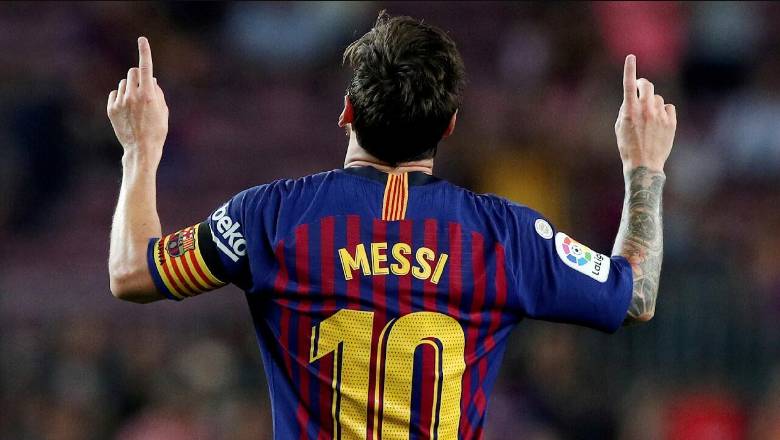
1. Lionel Messi (2004-2021)
For many, Lionel Messi stands alone as the greatest player in the history of FC Barcelona. He arrived as a quiet 13-year-old dealing with a growth hormone deficiency and, over the next two decades, developed into the defining figure of an era.
Messi made his first-team debut at 17, notably setting up by Ronaldinho in a moment widely viewed as a symbolic handover. His game evolved further under Pep Guardiola, who repositioned him from the right flank into a false nine role. That tactical shift proved decisive, forming the foundation of Barcelona’s treble-winning campaigns in 2009 and 2015.
By the time he departed, Messi had made 778 appearances and scored 672 goals for the club. Six of his eight Ballon d’Or titles were earned during his time in Barcelona colours, underlining a period of sustained dominance.
Famous players who played for Barcelona
5. Andrés Iniesta (2002-2018)
4. Xavi Hernández (1998-2015)
3. Ronaldinho (2003-2008)
2. Johan Cruyff (1973-1978)
1. Lionel Messi (2004-2021)
Nowgoalmobi has revealed FC Barcelona’s logo meaning, while also listed some famous players who played for Barcelona.
Visit our site to explore the latest football results, breaking news, and in-depth predictions from our experts.
The Most Popular
-
 When does the English Premier League start? Top 5 most decorated clubs of the league
 -
 Belgium football kit history: Ranking the greatest kits ever
 -
 Who is the captain of the Argentina football team in 2022? The year Argentina conquered the world
 -
 Top 5 players fastest to 100 Premier League goals: Erling Haaland etches his name into history
 -
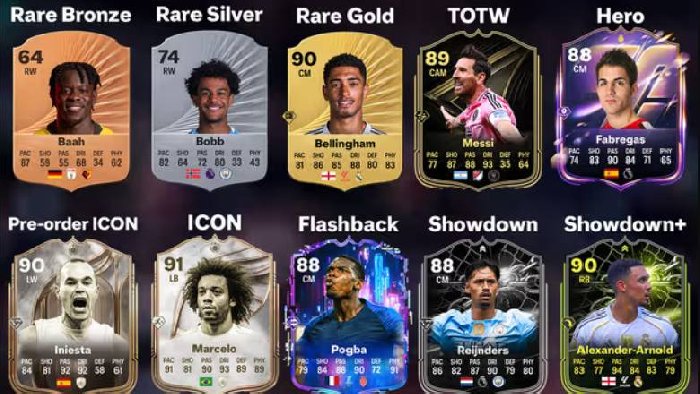 How are FIFA player ratings calculated? Breaking down the secret behind the numbers on the card
 -
 All Neymar’s jersey numbers: Featuring both 7 and 10
 -
 Japan national football team players at World Cup 2026: 11 stars who can take the Blue Samurai deep
 -
 Why did Edinson Cavani leave PSG? Uncovering the real story behind the Uruguayan striker’s exit
 -
 How much did Bayern pay for Mane? Top 5 Bayern Munich’s record signings
 -
 How much did Tottenham pay for Richarlison? Top record signings of Tottenham